Blossom Game: A Practical Guide to Playing, Finding Words, and Improving Your Score
I have a soft spot for word games that look simple when you first open them but become surprisingly difficult after a few rounds. Blossom Game is one of those games.
The basic idea is easy: you get a group of letters arranged like a flower, and your job is to create words from them. The challenge is that the center letter has an important role, and finding several valid words from the same small collection of letters can take more thought than expected.
What I like about Blossom is that it does not require a long session. I can play a few rounds while waiting for an appointment, taking a break from work, or simply when I want something more useful than endlessly scrolling through social media.
If you are new to the game, though, the first few puzzles can feel frustrating. You may see several letters and immediately think you have used every possible combination, only to discover that there were still a handful of words hiding in plain sight.
This guide explains how Blossom works, how I approach a difficult puzzle, common mistakes to avoid, and a few practical techniques that can help you become more comfortable with the game.
What Is Blossom Game?
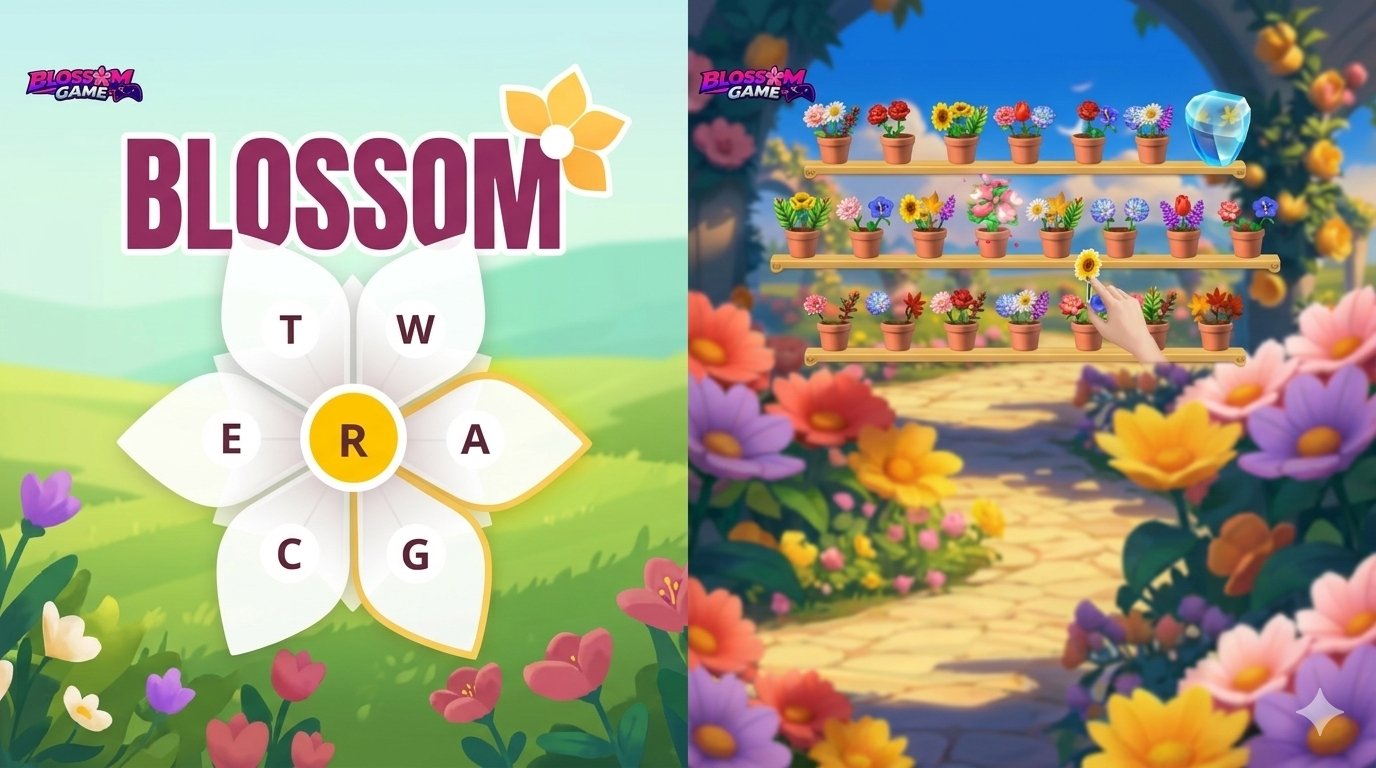
Blossom is a daily-style word puzzle in which letters are arranged around a central letter. Players use those letters to form words while following the game's rules.
One of the most important rules is that the center letter must be included in every valid word.
For example, imagine the available letters were:
Center: A
Other letters: B, C, D, E, L, R
You could look for words containing A while using only the available letters. Depending on the exact puzzle rules, words may contain repeated letters, so the task is not simply about arranging each letter once.
The flower-shaped layout is part of the appeal. It gives the puzzle a visual identity that makes it different from a traditional crossword or a standard word-search game.
The real challenge is not usually finding one word. Finding one word is often easy. The challenge is finding many words from the same letter set without overlooking less obvious possibilities.
How to Play Blossom Game?
If you have never played before, I recommend starting without worrying about your score.
Open the game on your phone, tablet, or computer and look at the complete group of letters.
Step 1: Identify the center letter
Start with the center letter because every word needs to contain it.
I usually say the letter aloud in my head and immediately think of common words containing it.
If the center letter is S, for example, I might start with simple words such as:
sand
seat
star
size
stone
The exact words available will depend on the surrounding letters.
Step 2: Look for short words
Do not begin by hunting for long, complicated words.
Short words are useful because they help you understand which letter combinations work. They also get your brain moving.
Suppose you have the letters:
A, C, E, L, M, R, T
with A in the center.
You might test combinations involving:
Not every example will necessarily be accepted in a particular version of the game, but this is the kind of scanning process I use.
Step 3: Build longer words
Once I have found the easy words, I start extending them.
For example:
art → arts → start
or:
care → cared → career
This is one of the easiest ways to uncover words you would not think of immediately.
Instead of treating every word as completely separate, look at words as families.
Step 4: Look for repeated letters
This is an easy detail to miss.
Many players assume that because a letter appears only once in the flower, they can only use it once in a word. That can cause you to overlook perfectly valid possibilities when the rules allow repeated letters.
When I get stuck, I deliberately test repeated-letter patterns.
For example, if the available letters allow a word beginning with B, I will think about patterns such as:
double consonants
repeated vowels
common endings
This small change in thinking can uncover several additional words
My Method for Solving a Difficult Blossom Puzzle
When a puzzle is easy, I simply play. When it is difficult, I switch to a more systematic method.
Here is the process I normally follow.
1. Make a mental list around the center letter
Let's say the center letter is E.
I think about common patterns:
e + consonant
consonant + e
vowel + e
common endings such as -ed, -er, -es, and -ing
I am not trying to solve the puzzle yet. I am simply creating possibilities.
2. Search for common prefixes
Prefixes can make a big difference.
If your letters allow something like re-, un-, de-, or pre-, test whether adding the available letters creates legitimate words.
You may suddenly discover a group of related words rather than just one.
3. Search for common endings
This is probably one of my favorite tricks.
After finding a word such as play, I check whether the available letters allow:
played
player
playing
Again, the exact rules and available letters determine whether each one works.
The point is to stop treating the puzzle as hundreds of unrelated combinations.
4. Think about word families
Suppose you find:
care
Now ask:
“What other words are built around this?”
Depending on the available letters, possibilities could include:
cared
cares
careful
career
Not all will fit the puzzle, but thinking in families is much faster than randomly combining letters.
5. Look for unusual words only at the end
This is where I used to waste time.
I would get stuck and immediately start thinking about obscure words. That usually made the puzzle harder.
Now I save unusual vocabulary for the final stage.
First, I exhaust:
common nouns
verbs
adjectives
plurals
common word endings
obvious longer words
Only then do I start thinking about less familiar vocabulary.
A Practical Example
For example:
rate → later
or:
pear → pearl
The purpose of this example is not to provide an answer key. It shows how I break a puzzle into manageable pieces instead of trying to solve everything at once.
That approach becomes especially useful when the letter set looks awkward.
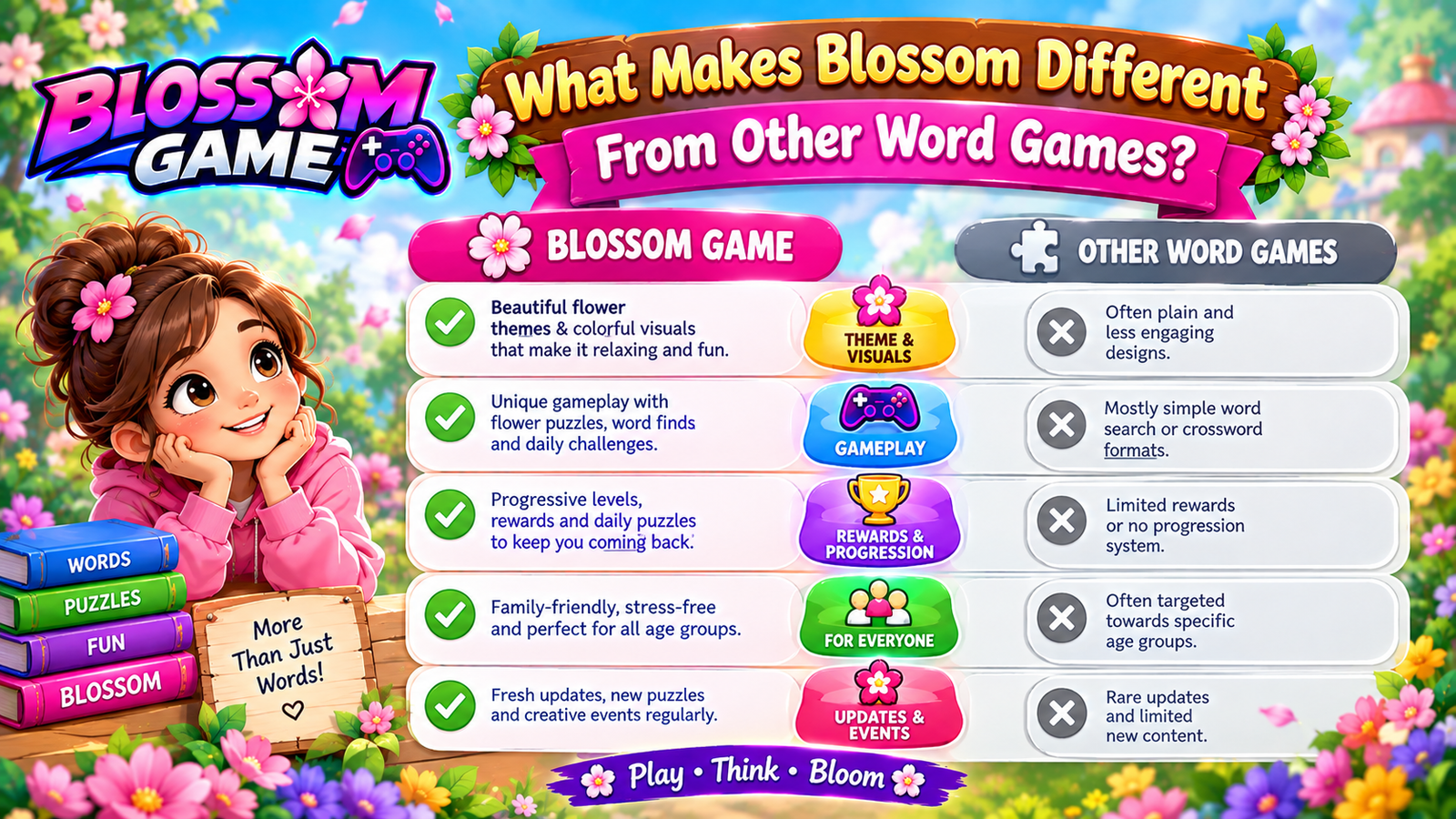
What Makes Blossom Different From Other Word Games?
If you have played games such as Wordle, crosswords, or traditional anagrams, Blossom can feel familiar while still requiring a different approach.
With Wordle, you are usually trying to identify one target word within a limited number of guesses.
With a crossword, clues guide you toward specific answers.
With a traditional anagram, you may be rearranging a fixed group of letters.Blossom is more open-ended. You are often trying to discover as many valid words as possible from the same letter set.
That changes the mindset.Instead of asking:
“What is the answer?”
I find it more useful to ask:
“How many different word patterns can I find?”
That small change makes the game feel much less restrictive.
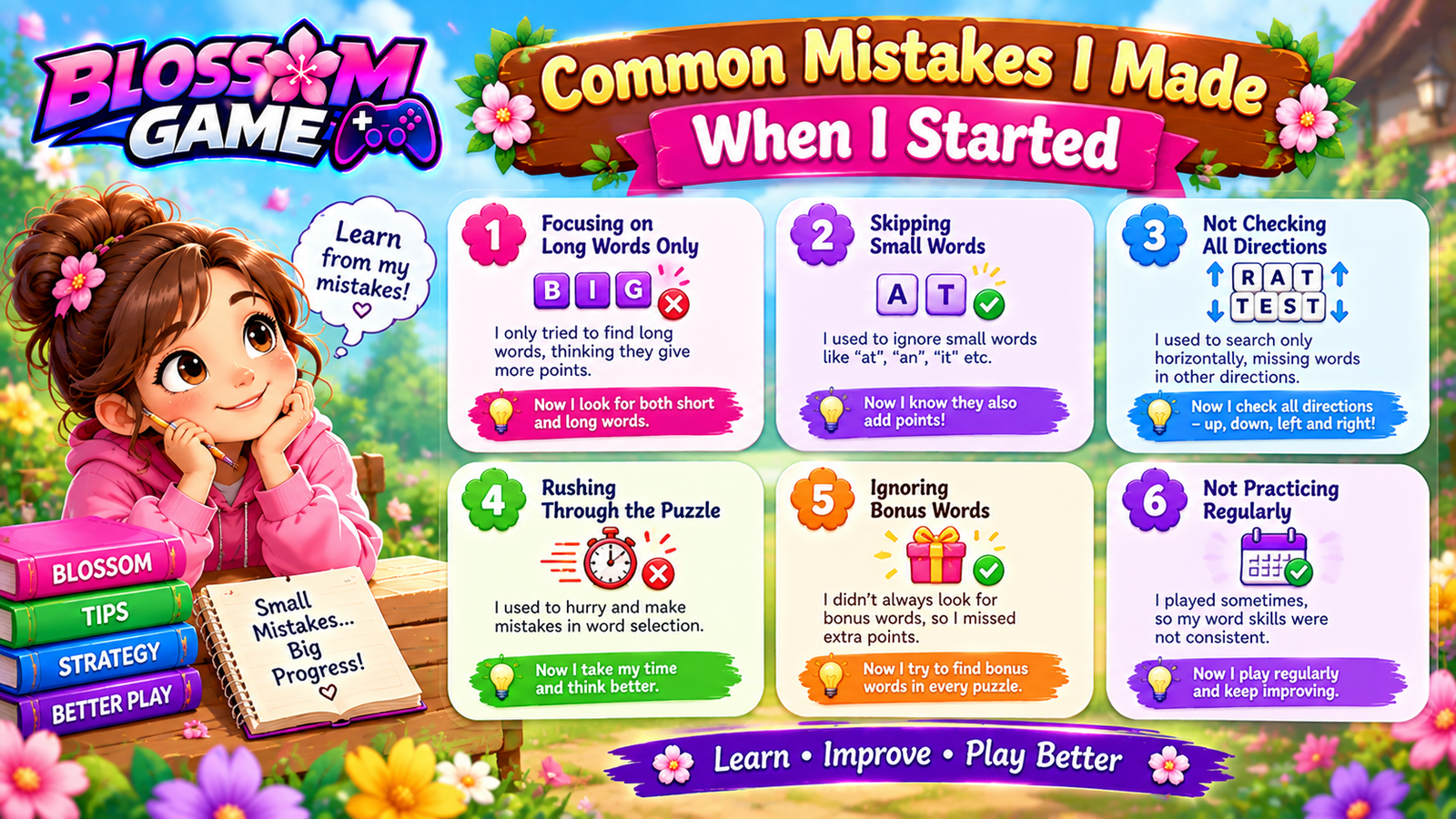
Common Mistakes I Made When I Started
Trying to find the longest word first
Long words look attractive because they can feel like a shortcut to a better result.
But spending five minutes searching for one complicated word while missing several easy ones is not a good strategy.
I now collect the simple words first.
Forgetting the center letter
This sounds obvious, but it is surprisingly easy to do when you become focused on a possible word.
I have definitely typed a word that looked perfect, only to realize that it did not contain the center letter.
Before submitting a word, quickly check the center letter.
Assuming every familiar word is accepted
Word games have dictionaries and specific rules. A word that seems perfectly normal to you may not be accepted.
The opposite can also happen: a word may be valid even though you rarely use it.
If a strange-looking word is accepted, I usually remember it. These small discoveries gradually improve vocabulary.
Getting stuck on one letter combination
Sometimes I become convinced that a certain letter pair must lead to another word.
That can waste a lot of time.
When a pattern produces nothing after several attempts, move on.
Returning to it later often works better because your brain has stopped forcing the same idea.
Can You Use a Word Finder?
Yes, word-finding tools exist, and they can be useful in certain situations.
However, I would not use one immediately every time I get stuck.
For me, the fun disappears if the entire puzzle becomes:
Copy letters.
Paste them into a solver.
Copy the answers.
Finish.
A better use is to treat a word finder as a learning tool.
For example, if I have found 15 words but cannot find anything else, I might check a solver after spending some genuine time on the puzzle.
Then I look at the missed words and ask myself:
Why did I overlook this?
Was it a word family? An unusual ending? A repeated letter? A word I simply did not know?
That makes the tool more useful than simply copying answers.
Playing Blossom on a Phone
Blossom-style word games work well on smartphones because you do not need special hardware.
A normal Android phone or iPhone is enough. You can also play from a desktop browser if you prefer a larger screen.
If you are playing on a phone, I recommend:
keeping your browser updated
using a stable internet connection
avoiding unofficial sites that aggressively open pop-ups
checking the spelling of a word before assuming the game is wrong
keeping the game tab open if you want to return to the same puzzle
I personally prefer playing with the phone in portrait mode because the flower arrangement is easier to scan visually.
A Simple Routine for Improving
If you want to get better rather than simply finish today's puzzle, try this routine.
First five minutes
Find all the obvious short words.
Do not worry about your score.
Next five minutes
Search for:
longer words
plurals
verb forms
common suffixes
words from the same family
Final few minutes
Look for unusual vocabulary and combinations you have not tested.
If you are still stuck, take a break.
This last part matters more than it sounds. When I stare at the same seven letters for too long, I start seeing the same combinations repeatedly. Walking away for ten minutes can make an obvious word suddenly appear.
How Blossom Can Fit Into a Daily Routine
One reason I like this type of game is that it does not require a large time commitment.
You could play it:
with your morning coffee
during a short commute when you are not
a lunch break
while waiting at an appointment
as a short evening activity
with a friend or family member
It can also be a fun way to compare vocabulary with someone else.
For example, one person may immediately find unusual nouns while another is better at spotting verbs. Instead of competing over who finishes first, you can compare which words each person discovered.
That makes the game surprisingly social for something played on a small screen.
Is Blossom Good for Improving Vocabulary?
It can certainly expose you to unfamiliar words, although I would not treat a word game as a complete vocabulary-learning program.
The useful part is repetition.
When you encounter a word you do not know, look up its definition from a reliable dictionary and then try to use it in a sentence.
For example, if the game introduces you to a word you have never seen before, do not just memorize the spelling. Learn:
what it means
how it is pronounced
whether it is a noun, verb, or adjective
how it is normally used
That turns a random puzzle discovery into something you may actually remember.
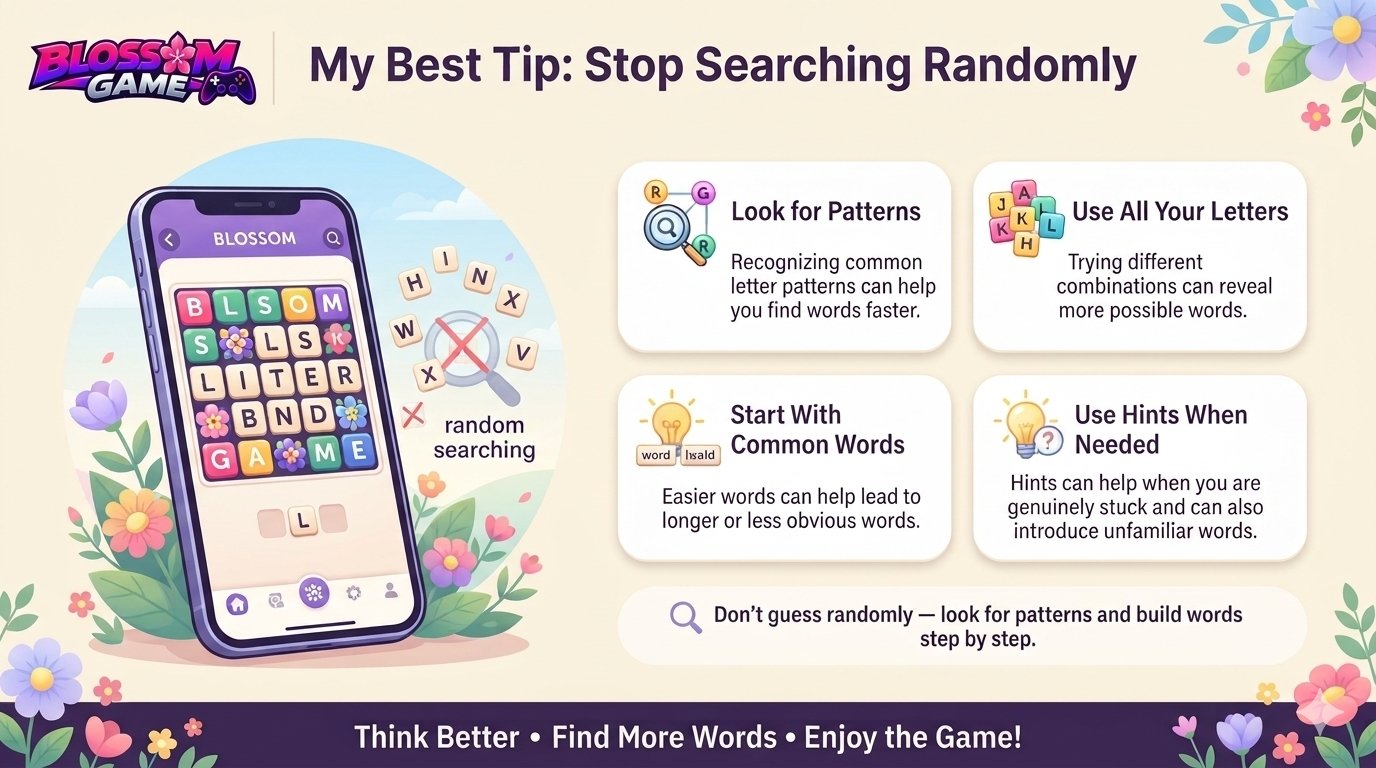
My Best Tip: Stop Searching Randomly
If I had to reduce my Blossom strategy to one practical lesson, it would be this:
Do not treat the letters as a pile of random characters.
Look for patterns.
Start with the center letter. Find easy words. Expand them. Check common endings. Think about word families. Then search for unusual possibilities.
Once you develop that habit, difficult puzzles become much more manageable.
And there is another benefit: you start noticing word patterns outside the game. While reading an article, writing an email, or watching a video with subtitles, you may recognize prefixes and suffixes that you previously ignored.
Final Thoughts
Blossom is the kind of word game that is easy to understand but has enough depth to keep a puzzle interesting. You can play casually for a few minutes, or spend much longer trying to squeeze every possible word out of a difficult letter set.
The biggest improvement usually does not come from memorizing hundreds of obscure words. It comes from changing how you search.Start with the center letter, collect the obvious words, build word families, test common endings, and leave the unusual vocabulary until later. When you make a mistake, pay attention to why you missed the word instead of simply moving on.
After a while, you may notice that you are not staring at the flower and wondering what to type anymore. You are seeing patterns—and that is when Blossom starts becoming genuinely satisfying to play.
My Best Blossom Game Tip: Stop Searching Randomly and Think Smarter